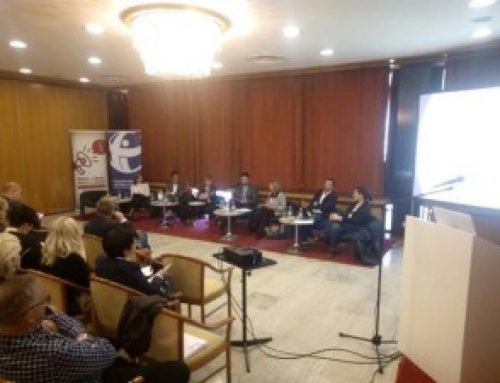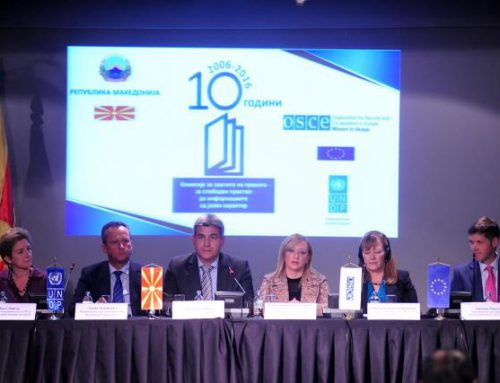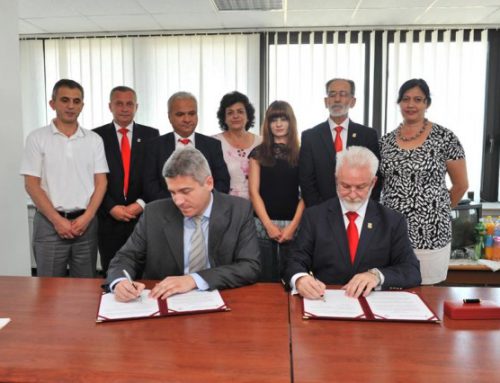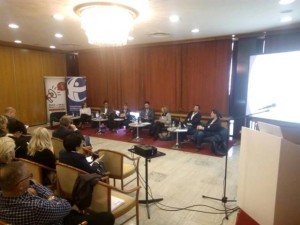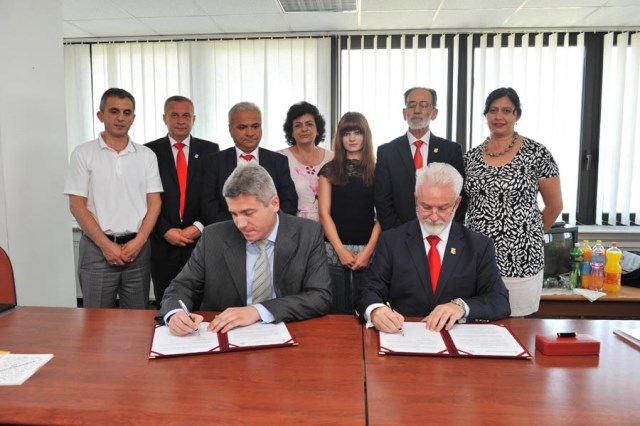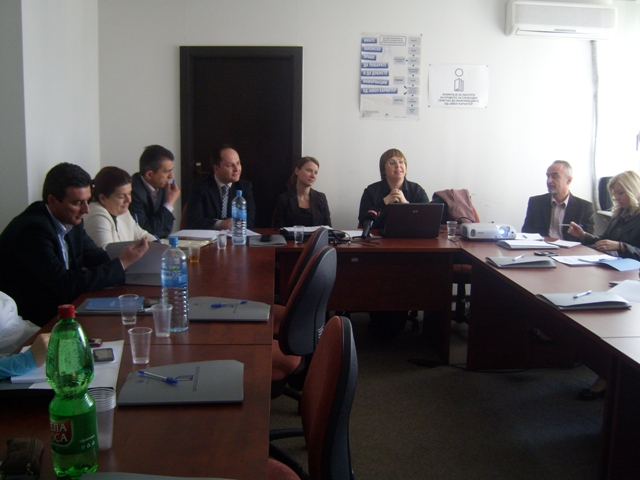
 In the past two days in the premises of the Commission for Protection of the Right to Free Access to Public Information, with support of TAIEX instrument of the European Commission, was held “Expert mission for implementing the requests on free access to public information”. Besides experts from Slovenia, Natasa Pirc and Polona Tepina, members of the Commission and employees in its secretariat, at this meeting also participated the President of the Legislative Committee of the Assembly of the Republic of Macedonia, Blagorodna Dulic, the Dean of the Faculty of law, Professor Dr. Borce Davitkovski, representatives of the Ministry of Justice and the Ministry of Information Society and Administration, as well as members from several non-governmental organizations , which are actively working in the field of free access to public information.
The event was opened by Pece Tashevski, the President of the Commission, who noted that the Commission at this meeting in interaction with the guests will compare and exchange experience on the implementation of laws in both countries, and that in the future through various forms and projects will work more intensively on the approximation to the European legislation. Tashevski expressed hope that after the meeting, the Commission will gain new insights which will be of valuable importance and will contribute to the successful implementation of the Law on Free Access to Public Information in the Republic of Macedonia.
Information Commissioner of the Republic of Slovenia, Natasa Pirc, said that effective law is just a good a basis for regulating relations in the sphere of free access to information, but its successful implementation depends mostly on the people responsible for handling information, as well as the body in charge to oversee the implementation of the legal provisions. Sisyphean toil is to change the mentality of the officials and to convince them that it is good for the whole society to provide large amount of information, suggested Pirc adding that Slovenia receives valuable assistance by non-governmental organizations, especially in the area of education. In Slovenia, The Office of the Commissioner is arbitrator between the applicants and the holders ie their advisory service, clarify Pirc, and transfer experience for her proceedings in a few specific cases.
Pirc informed that in terms of The Law on Free Access to Public Information, recently the trend in developed European and world’s democracies is so-called proactive transparency or open data, whereby public institutions know that should place more information on their web pages, by what they make easier their work because will face with less number of requests, the information will be available 24 hours a day, and neither they nor the applicants will not have any cost for giving or receiving the information.
In Slovenia, according to Pirc, every public authority is obliged to have its own portal where will place information, but on the other hand, if an information is presented on internet, the applicant should be told just the right link that leads to it.
The expert Polona Tepina focused on comparative experiences of Slovenia and EU in terms of the manner of submission of the requested information and the form in which they are submitted to the public. In Slovenia, apart from some European countries, where identification is required, the application can be submitted without consideration the obligation for electronic signature, the applicant does not need to write the request only on the form provided for that, nor to invoke explicitly that requires information according to the Law on Free Access to Public Information.
Commenting on the European experience in terms of the Tariff for administrative costs, Tepina noted that depending on the form, scope, and above all, the purpose for which the information is requested, certain institutions in European countries may charge services even require a deposit, according to previously determined Tariff accepted by the competent Ministry, which must be published and transparent. But in any case the intention is clear – the cost to be reasonable, i.e. are not discouraging, not to pose a “weapon” against the applicant, and of course cannot be basis for running profit.