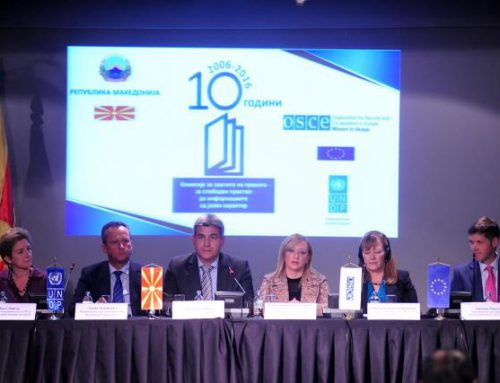
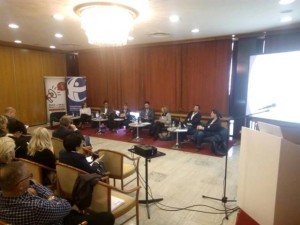
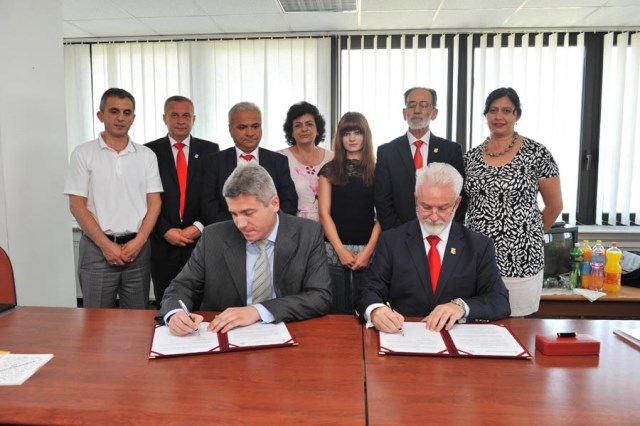
The Commission for Protection of the Right to Free Access to Public Information marked today the third anniversary since the implementation of the Law on Free Access to Public Information. The President of the Commission, Janko Nikolovski, addressed the present guests, and concluded that the awareness of the citizens concerning this Law is significantly increased. The 1230 submitted complaints about denied access to information are a proof that the citizens are getting well acquainted with the existence and of the Law and are not afraid to use it.
“The rising of the awareness is the greatest success since the application of the Law and in this aspect, the Commission will continue to fight with the lack of transparency of the institutions”, stressed Nikolovski. He gave his gratitude to the British Embassy in the Republic of Macedonia for the financial support in the project “Technical Assistance and Rising of the Awareness for the Support of the Application of the Law on Free Access to Public Information” in RM, carried out by the Commission in cooperation with the Macedonian Institute for Media. This project enabled the promotion of the new legal right of the citizens of the Republic of Macedonia, as well as training and a thorough education of the official persons of the information holders and of the Commission and its expert service, explained Nikolovski.
Ljubica Stanojovska, member of the Commission, informed that the Commission has prepared special Information for the official persons and the journalists, which gives information about the activities of the Commission in the last 3 years since the application of the Law on Free Access to Public Information. She invited the official persons and the journalists to address the Commission about any dilemmas, especially in cases of certain special requests.
In the last 3 years, according to the gathered data, the citizens submitted 605 complaints against educational institutions and 405 against state institutions. 81 complaints have been submitted against the organs of the local self management, 41 against the court authorities and 39 against the political parties. 35 complaints are against shareholders companies and 24 against public enterprises and institutions.
In the largest number of cases the complaints are submitted on grounds concerning budget and donors’ means, issuing different licenses, public procurements, construction works, personal and property rights, higher education institutions self-financing incomes, education plans and programs, publishing activities of the faculties, number of new employments etc.